The creative side of doing science
If you have started a PhD in physics, “creative” is probably not the first adjective you would use to describe yourself. Afterall, creativity belongs to artists alone… doesn’t it?
I used to think so too. I often associated creativity strictly with artistic disciplines, but my conversation with Maria Cristina helped me change that assumption.
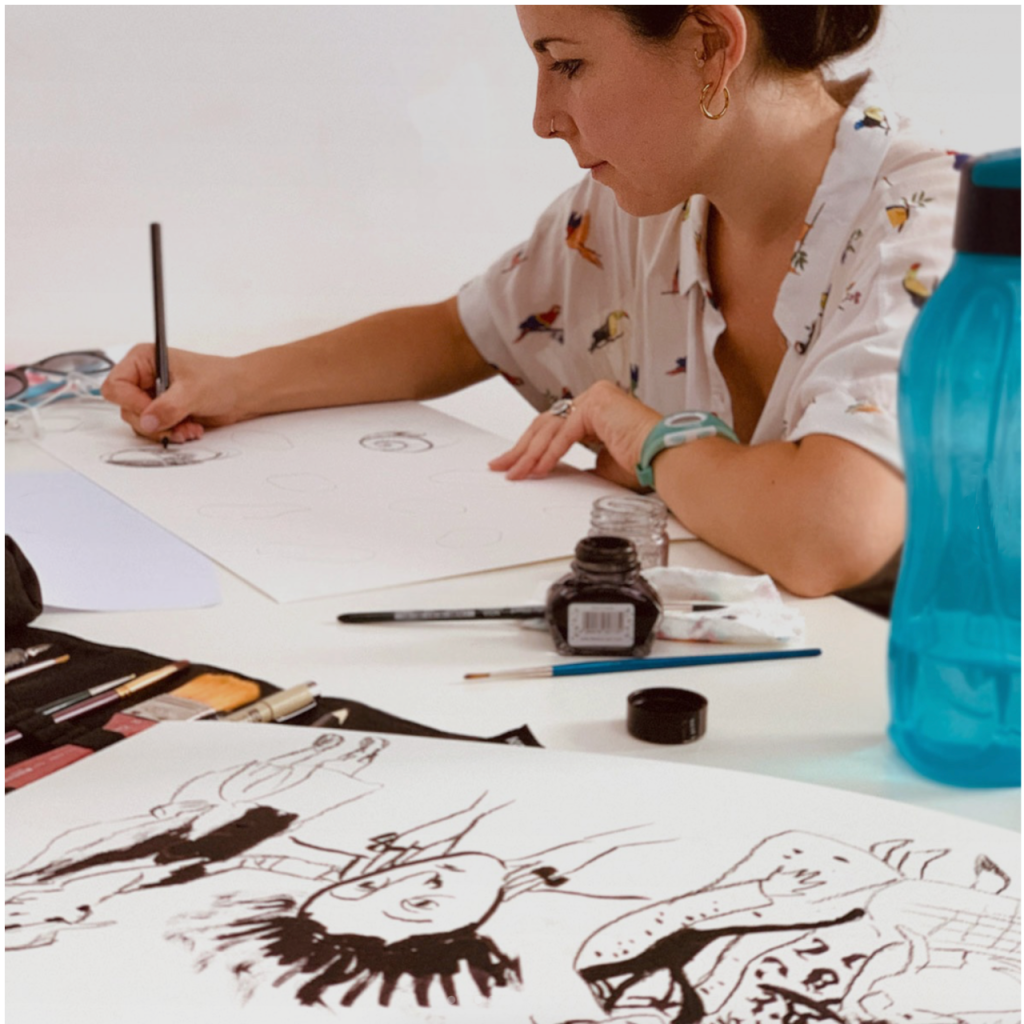
Maria Cristina is a physicist with a PhD in Astronomy who now works as a scientific illustrator, creating commissioned illustrations, taking part in art-and-science festivals, and running hands-on creative and science workshops for children. She is also currently doing a postdoc at the INAF Astrophysical Observatory in Arcetri (Italy), as part of the science communication team of the Wide-field Spectroscopic Telescope (WST)1.
In truth, illustration has always been part of her hobbies. For instance, she remembers joining painting classes while in high school. Choosing which university study to follow was not easy, as the choice was between Physics and Arts! At the end, Physics won and, because she enjoyed that, later came also a PhD in Leiden (The Netherlands) with focus on the intrinsic alignment of galaxies2.
When her PhD ended, the idea to give her career as an illustrator a serious chance did not come as a bolt from the blue. Several factors influenced this decision. It started with the feeling that she was missing drawing during her PhD, but it was necessarily something that did not fit that busy period of life. In the middle came a wonderful experience of a volunteering job at a refugee camp in the Netherlands. The idea was to entertain children a few afternoons a week with little experiments, little plays and manual activities all inspired by astronomy. The tricky part was that none of the children was speaking English, at most a bit of Dutch, so the language barrier was great. It was at that moment that drawing came to the rescue! And with that she realised that creativity can also be a mean to bring science closer to the public, in this case a young public. Lastly, although still in love with science, she realised that doing research in such a highly specialised way was no longer fulfilling her. She was rather looking for a broader vision, one that would allow her to learn from other fields as well. Although she felt that her experience as a researcher was over, she was still keen to remain connected to science.
It was with this new awareness that she registered for a course on digital illustration at Scuola Internazionale of Comics, and later a master on editorial illustration in the same school, both of which didn’t have a focus on scientific illustration. Only with her master’s project, she brought together again her two worlds by developing a graphic novel about scientists, one I look forward to read!
Art uses a completely different methodology compared to science and that meant learning… a new way of learning. Plus, to become an artist, you need to develop your own taste and that takes time, commitment, curiosity… So, even if you love what you do, it doesn’t mean that it is less easy or comes with less struggles. Luckily, some skills lift the process up a bit when you are mixing science and illustration, for example the ability to read a paper or a research project. “Despite the field you are coming from, you can be sure that the structure of a paper stays the same” she said.
A few years now into this field, she has learnt her own way to bringing together scientific rigor with creativity. When she needs to work on an infographic, for instance, she needs to dive deep into the scientific content and simplify it, without loosing the scientific accuracy. When she needs to come up with an illustration inspired by a scientific concept, the elements that become important for her process are wonder and the imaginative side of science.
Science has an imaginative side? “Yes!” she says! “Since I live at this weird intersection, I often marvel at things I read or see. It is as if I am allowing creativity to really touch them and imagine that they might be real.” At the same time, she recognises that an excessive analytical approach, so essential in research, can also create a certain rigidity. Take for example researchers that discover things almost bordering the mystical aspects of life or the way Nature works, and are not able to perceive the element of wonder or, if, they do and are open about it, can be ridiculed. Being able to wonder when you know the little things about the functioning of Nature is a beautiful quality to possess as a researcher.
Listening to her, it becomes clear that creativity is not something external to science, nor a separate path. It is already there, in the ability to connect dots in a non-obvious way, figure out connections that you cannot explain at first, or see the same riddle from a new fresh prospective! These are all creative skills, unfortunately often missing from the common narrative of doing good research.
Finally, to all aspiring PhDs out there, she suggests finding a project within a collaborative consortium of institutes and/or universities. This helps to keep up the enthusiasm and to discuss anything, good and bad, with other fellow PhDs. “A good PhD project can give an important imprinting to your future career”, she says, “Therefore do not stop at the first PhD position you may lay eyes on”.
And, even if your career takes you along a different path, you are still able to benefit from that wide network you built during your PhD!
To connect with Maria Cristina, you can visit her website https://www.mariacristinafortuna.com, or look her up on Linkedin https://www.linkedin.com/in/maria-cristina-fortuna-6b8ba724b/ and IG as @maricri.fortuna
The science behind the story
1 The Wide-field Spectroscopic Telescope is a concept study for a new telescope that will be proposed as the next ESO facility to operate in 2040+.
2 During her PhD, Maria Cristina developed a theoretical model to describe the intrinsic alignment of galaxies. Galaxies form inside massive structures called dark matter halos, which are connected through the cosmic web. Because of these connections, galaxies are not randomly oriented but can exhibit preferred alignments.
Understanding these intrinsic alignments is crucial because they can interfere with measurements of weak gravitational lensing. In weak lensing, the gravity of matter between us and distant galaxies bends the light coming from those galaxies, slightly distorting their apparent shapes. Cosmologists use these distortions to study the distribution of matter in the Universe.
However, if galaxies are already aligned before their light is distorted by gravity, scientists must account for that intrinsic signal. Maria Cristina's work contributed to developing models that separate these two effects, enabling more accurate cosmological measurements.