I recently had the opportunity to chat again with Katharina about her PhD path. She graduated last December and now she is happily working as Education Specialist in Wageningen.
Like, Miguel, she was one of my students during the MSc thesis. Among other things, at that time her proactiveness to find solutions to practical problems we encountered in the lab and in the greenhouse was impressive. Probably, that experience left in her the seed of a PhD along with the curiosity to see what it means to handle a full project, from the idea to its realization.
Indeed, when we talked about the Why that convinced her to start a PhD, I wasn’t surprised when she said that she liked the idea of working on an actual problem and, therefore, contributing to a bigger purpose.
However, like many students experience, the PhD can be a perilous journey: half-way she started to feel anxiety. Fortunately, she sought of asking for help. It must have been heartwarming to hear from one of her supervisors this powerful and liberating advice: “Stay true to yourself”. Because it’s important to remember that it is not a shame to feel not good when you are under a lot of pressure and to say it out loud. To even consider taking a step back and prioritize your own wellbeing over everything else. It requires more courage than continuing on the set path.
Those words allowed her to reconnect with the initial Why and persevere through the journey not for the title that awaits at the end but for the passion and the challenge that a PhD poses.
It is a steep learning curve!
For Katharina, it also meant to realize how important it is to balance PhD life with other activities, preferably those that have nothing to do with the work she did, so that she could disconnect and restart the next day recharged.
This is also a beautiful way to get “contaminated” by something different rather than just the area you are interested in, where little by little, you become the expert. I see also an interesting extra value to it, which is to learn soft skills that might come in handy in your future career. Indeed, soft skills are transferrable to many circumstances because they are related to the how you do certain things opposed to the hard skills that relate to the what you are able to do. For example, Katharina realized that a good lesson from the relationship with her supervisors is to have learnt to communicate more efficiently and to have benefitted from this skill also later in the job she landed after the PhD.
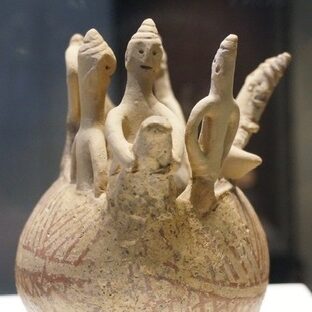
Artifact I photographed in Paris at the Museum of Louvre in 2018
Last but not least, Katharina’s advice on a healthy PhD experience is to talk to your peers. Sharing your own struggles with others makes you realize that we are all on the same boat and so we can understand, feel and support each other. Then you discover that a friend, disguised in a white coat, sometimes is just a cup of coffee away!
Motivation is the process that starts, guides and sustains a PhD journey. At the beginning is the trigger that jump starts you. Afterwards, it becomes the drive that pushes you to continue till you reach your objective: getting the PhD.
Nevertheless, even with this clear objective in mind, your motivation will fluctuate because there will be periods when you are under a lot of stress and there is a lot required from you. Many times you will think “This is all too much!”. Those are the moments when you feel the finishing line getting far away.
How to get back your motivation in these situations?
I started talking about this with Miguel, a PhD student of Plant Breeding at Wageningen University (NL). Miguel and I know each other since his MSc thesis when I was his daily supervisor. I remember his curiosity regarding the topic we were studying together, often coming into my office to discuss about something he had read with such an enthusiasm!
For Miguel, motivation has two faces.
On one hand, he realises to be working in the best university of the world when it comes to Plant Science, which makes him proud; and, during these past four years, he has developed competencies and technical skills that allow him to actually be doing great research! It is known that the more competences you learn the higher the satisfaction in performing the activities you are busy with. This increases your self-efficacy and, consequently, your self-esteem, boosting your motivation back up.
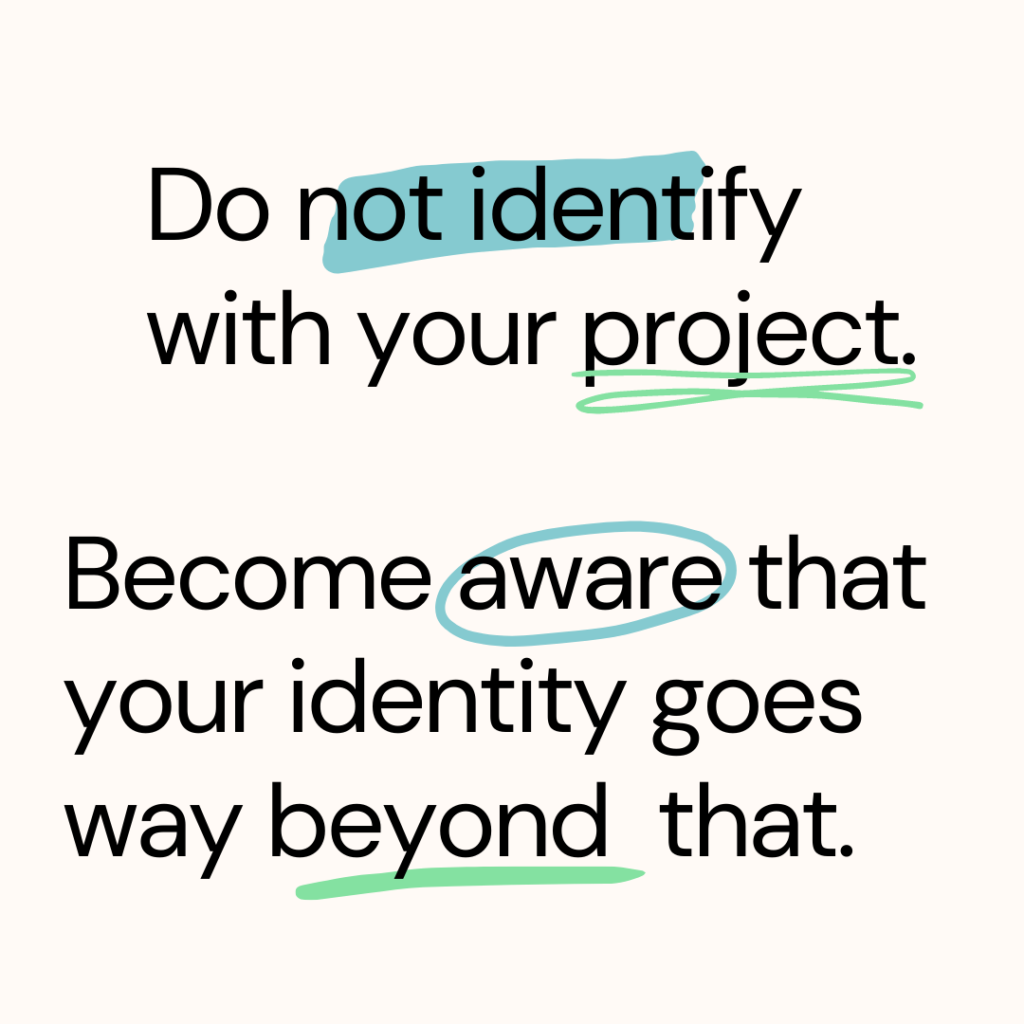
On the other hand, Miguel has realised in time that the job that he does, as a PhD student, although sometimes may seem encompassing all that he is, actually does not define who he is. This is a beautiful lesson of self-awareness which led him to look for a more balanced work-life style.
Another core lesson, linked to the previous one, regards a good PhD student-supervisor relationship. He says: “You need to learn the art of negotiation, of saying no, of setting priorities and how to get what you need. To achieve these goals, you need to know yourself and where your boundaries are.”
In this process of hard work and self-discovery it is easy to feel lonely and misunderstood or to hit a wall in your research. At that point do not forget to reach out to your peers, talk to them, initiate collaborations. Ask questions. Be brave. There is a lot to gain from this experience. And from the whole PhD journey.
I now realize that consciously or unconsciously I’ve been interested in getting to know somebody’s unique story and, through that, be able to connect with people. As Lenny nicely put it, I cannot just go around and suddenly come up to somebody asking ‘So, what’s your story?’.
Lenny is now a toxicologist but we know each other from her MSc time in Wageningen, before her successful PhD and post-doc track. So, she knows that I might just come up with that question unannounced!
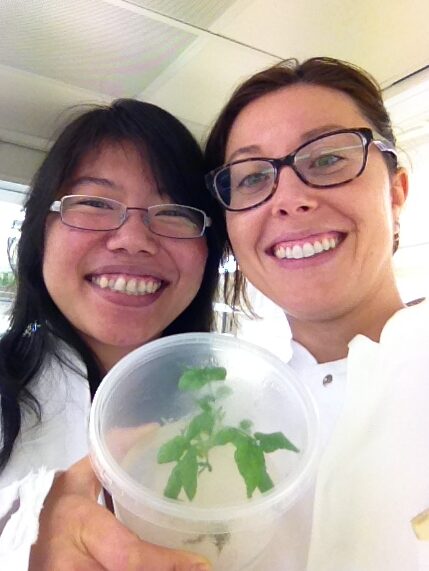
Lenny and me holding one of mine tomato in vitro plant, 2016.
Anyway, this time I’ve decided to be slightly less odd and take a little detour by talking instead about coffee drinking and traditions as part of one’s culture to reconnect to when you feel particularly lonely.
For her the simple act of making and drinking coffee, for example, is a way to reconnect to her Indonesian identity.
Incredible what one may discover just around a chat on coffee, eh?!
How did we come to that? Starting by asking ‘How do you take your coffee? ‘.
Lenny prefers coffee served warm. She uses the ceramic cone and coffee-filter paper which allows to make the perfect pour-over coffee. The nice thing is that you can smell the aroma of freshly brewed coffee. Not any coffee though: a cup of Indonesian specialty coffee!
The taste of Indonesian coffee varies according to the place where the beans come from: coffee from Bali (e.g. Kintamani) is nutty and citrusy, the one from Sumatra (e.g. Aceh Gayo) has a strong earthy aroma, the one from Sulawesi (i.e. Toraja) is smooth and easy to drink, overall quite famous.
The magic that happens by drinking Balinese coffee is that while sipping she feels in Bali, although Bali is not the island from where she comes from. Nevertheless, it’s part of Indonesia and that’s something she wanted to reconnect to because, being so far from home for a long time, she was afraid at some point to lose or forget her identity.
She started drinking coffee during her study time back in Indonesia when she drank instant coffee. However, that coffee (if coffee can be called!) caused her gastritis so she had to stop drinking it. She says that she tasted the real coffee when she started her coffee business together with a friend, who learnt to roast coffee beans to perfection in Australia.
She saw first her dad drinking coffee, of course. When she was little, her father would give her just a few little spoons because only adults are allowed to drink coffee.
His favorite way to prepare a good cup of kopi (Indonesian for coffee) is to add grounded coffee (mostly Robusta) to a cup, then sugar and later pouring hot water on it. Afterwards, he would wait till the cup had cooled down. This is the way most of Indonesian people enjoy their coffee!
There are also places where you can buy coffee. Those are called warung kopi (same name for both cup of coffee and coffee place). The two possible variations you can get at warung kopi are kopi hitam (black) and kopi susu (with milk). Going to a warung kopi is a moment dedicated to networking. Drinking coffee in Indonesia takes time so you share that time with friends and some times strangers that you may meet at the warung. Interestingly, every warung kopi is also a meeting point for people that do the same type of job or have the same hobby. This way you are sure you are going to have meaningful conversations about a topic you have at heart!
If you have never been in Indonesia you may not know that a real Indonesian specialty is kopi luwak as this is the result of a natural process of which Indonesians are very proud. Since the berries have been partially digested by an indigenous animal, the coffee that you obtain is much less acidic, and therefore perfect when you drink coffee first thing in the morning. On the other side of the spectrum, you find the coffee from the robusta species, which represents the most common type. This species grows everywhere in Indonesia and it’s cheaper than the Arabica but it can also be very strong as it contains more caffeine than those of the Arabica.
The coffee business she mentioned earlier sounded very interesting at this point so I asked her more about it. She told me that coffee was not an indigenous plant to Indonesia. However, during colonial time, farmers started to grow it within their tea plantations. At the start of the coffee business, her wish was that, as the Indonesian specialty coffee got known in the world, Indonesian people would also become more aware of the richness of diversity they have available. Moreover, by buying directly from the coffee farmers, she would pay them a fair price for their beans. Reality is that farmers would otherwise be getting very little for that. Together with his friend, she would then roast them light or medium to preserve as much as possible the flavor that could disappear by roasting dark.
Her knowledge in coffee making and flavors is quite broad. In time she has learnt that making coffee is also an art. So, every now and then she also tries cold brewed coffee but to make that you have to start brewing in the evening as it is a process that may take up to 8 hrs. The interesting thing is that making coffee at a different temperature allows to extract compounds that give different flavors to the coffee. So, depending on the mood and on the day of the week, she may go for a cappuccino made with Balinese coffee or a cold brewed coffee in the weekends when time goes a bit slower, or for a Sumatran black coffee during a working day for a good kick of caffeine.
I know at some point we diverged into technicalities of coffee. However, it’s important to realise that coffee flavours and ways of preparation reflect one identity. It’s a strong connection to where you come from and in way represents yourself. In Lenny’s case, it connects her to her family and her country and allows her to not forget how beautiful it is to be called Indonesian, especially in times where you feel lonely on a PhD journey far from home. Now that I see through her eyes, I understand the slogan stamped on her coffee bags: a taste of diversity, a cup of Indonesia.